


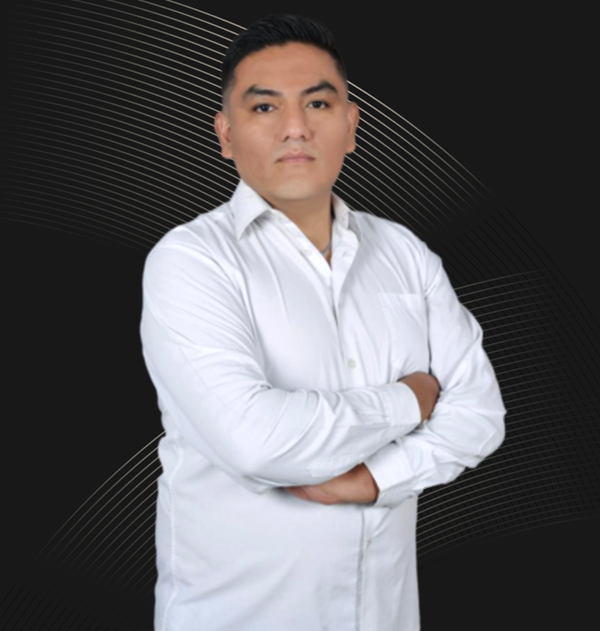
Dr. Omar Andres Bueno Alcoba (Bolivia)
- 2025년 11월 26일
- 2분 분량
Brief CV
MASTER'S DEGREE IN ORAL IMPLANTOLOGY PRIVATE TECHNICAL UNIVERSITY COSMOS UNITEPC BOLIVIA
CREDITION IN GUIDED SURGERY SAO PAULO BRAZIL AT THE KOOP INSTITUTE SAO PAULO BRAZIL
CREDENTIALING IN ZYGOMATIC IMPLANTS CTA FACCO TECHNIQUE, SO PAULO, BRAZIL
KOL SHINING 3D
KOL MICROPLANT

National Round
Title : Five Post-Extraction Implants with Stackable Magnetic Guides and Immediate Provisionalization for PF1-Type Rehabilitation, Based on Pre-Surgical Diagnosis in a Virtual Patient
Abstract : Current digital implantology integrates bone, dental, and facial data into a virtual environment, optimizing both surgical and prosthetic precision. This case describes a PF1-type rehabilitation with post-extraction implants, using stackable magnetic guides and immediate provisionalization, supported by three-dimensional pre-surgical diagnosis. The patient presented with compromised anterior teeth, indicated for extraction and subsequent rehabilitation. A facial scan was performed to correlate facial and skeletal planes, complemented by CBCT and digital models, thus creating a virtual patient. The surgery was planned with stackable dento-mucosa-supported magnetic guides, digitally designed and 3D-printed, and stabilized with fixation screws. During surgery, five post-extraction implants were placed. To ensure accuracy and guide stability, a partial odontosection was performed on one tooth, preserving key support points. This strategy allowed maintenance of surgical registration while achieving optimal angulation of an implant without compromising positional precision. Immediate provisionalization was achieved with digitally designed and 3D-printed temporary crowns, which were adapted and screw-retained during the same surgical session. This approach provided the patient with immediate esthetic and functional support, avoiding a period of edentulism. Results demonstrated that digital integration ensures intraoperative stability, accuracy in implant placement, and esthetic harmony. Facial scanning facilitated correlation with the patients facial planes, while selective odontosection and dento-mucosa support preserved guide precision throughout the procedure. In conclusion, the combination of virtual patient planning, stackable magnetic guides, selective odontosection, and 3D-printed digital provisionals represents an advanced and predictable protocol. This approach preserves tissues, enhances surgical accuracy, and optimizes immediate esthetic and functional outcomes, consolidating a modern standard for PF1-type rehabilitations.


댓글